By Bill Thomas | September 3
If you’re reading this on September 3, 2026, then today is officially the first-ever California Neuroblastoma Awareness Day. That’s thanks in no small part to La Cañada High School student and Pediatric Hope Project founder Mikaela Hong, who collaborated with California State Senator Renée Pérez to pass a resolution officially recognizing the day.
Hong’s advocacy doesn’t end there, however, and today isn’t just California Neuroblastoma Awareness Day. Today, in collaboration with Hong, California State Representative Judy Chu is introducing a similar resolution in the US House of Representatives. If passed, this resolution will codify September 3 not just as California Neuroblastoma Awareness Day, but as National Neuroblastoma Awareness Day.
“I thought establishing Neuroblastoma Awareness Day would be a great way to not only honor the patients and families affected by neuroblastoma, but also to advocate for more research funding,” Hong explains. “I feel like most people don’t really know what neuroblastoma is unless they’ve had some kind of personal experience with it. It’s a fairly common cancer in babies and, unfortunately, its mortality rate is very high relative to other childhood cancers.”
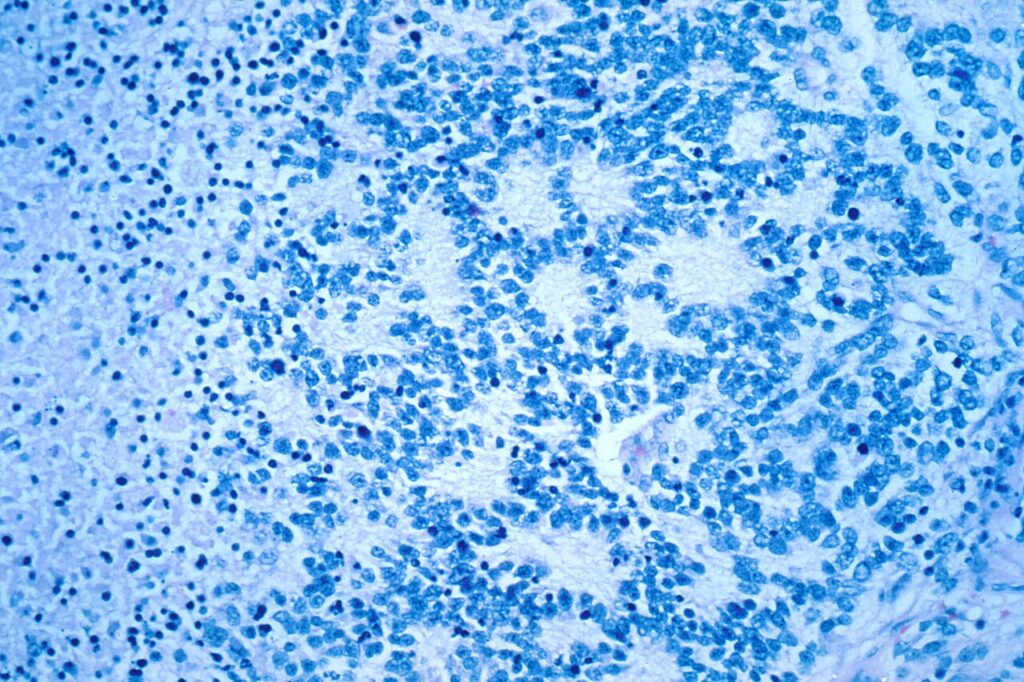
Indeed, neuroblastoma is the second most common solid cancer diagnosed in children behind brain cancers, accounting for roughly 15% of all childhood cancer deaths. An estimated 600–800 new cases are diagnosed annually, with 30–40% of those cases occurring in babies under 1 year old.

Searching for a Better Way to Treat Neuroblastoma
In 2024, Hong was one of several neuroblastoma patients who participated in a clinical trial at the Children’s Hospital in Philadelphia. Unfortunately, the therapy tested during the trial proved ineffective for Hong, who is now receiving a standard neuroblastoma treatment regimen of radiation and chemotherapy.
“One thing I would like more people to know is how limited treatment options are right now,” Hong says. “The standard regimen is really arduous and if it doesn’t work out for you, you’re kind of left scrambling. You feel like ‘I’ve exhausted my options, what am I going to do next?’ That’s why there really needs to be more research funding.”
In light of recent cuts to federal funding for childhood cancer research, Hong’s words resonate all the more strongly. Such obstacles haven’t dissuaded her from becoming actively involved in neuroblastoma research herself, however. Despite having no prior experience in a medical research lab, Hong’s eagerness to learn more about her condition led her to become a research assistant for Dr. Shahab Asgharzadeh, director of the Neuroblastoma Basic and Translational Program at Children’s Hospital of Los Angeles.
“I’ve been working there for a little over a year now and it’s been really amazing,” Hong says. “As a patient, obviously I’ve interacted with science and I’ve participated in clinical trials, but until now I’ve never really had the chance to learn the science behind how it works. My dream career is to get a PhD and become a cancer researcher.”
One avenue of research that Hong has been especially excited about is CAR T cell therapy. A personalized form of immunotherapy, CAR T cell therapy involves modifying a patient’s own immune cells so that they are better equipped to recognize and destroy cancer cells. In addition to its efficacy, the fact that CAR T cell therapy has fewer long-term negative side effects than radiation and chemotherapy makes it an attractive prospect for researchers investigating less toxic treatment options.
“CAR T cell therapy definitely has some hurdles to overcome, but there are labs all over the country working on ways to do that,” Hong says. “I think it has a lot of promise.”
Offering Hope to Childhood Neuroblastoma Patients
For families affected by childhood cancers, taking care of the patient’s physical health is of paramount importance. Sometimes overlooked, however, is the importance of taking care of their mental health.
When Hong first began receiving treatment for neuroblastoma, she struggled with feeling like an outsider. Spending less time in school and more time in the hospital, she increasingly felt disconnected and worried about falling behind in her education. That all changed when one of her teachers, Ms. Lloyd, took it upon herself to become Hong’s tutor.
Visiting her after school each day, Ms. Lloyd helped keep Hong from falling behind in her studies. More than that, though, she provided Hong with hope and a renewed sense of connection, bringing her letters from classmates and keeping her informed about what was happening at school.
Inspired by the experience, Hong subsequently founded the Pediatric Hope Project to provide free, virtual, one-on-one weekly K–12 tutoring and emotional support to children with cancers and other serious illnesses. In just a year and a half, Pediatric Hope Project has become one of the largest youth-led nonprofits in the United States, serving families across more than 43 states and 9 countries, with more than 600 registered tutors and 30 university chapters.
“I’m really proud and happy about all the relationships that have come out of this, all the friendships that have been built even in just a year and a half,” Hong says. “Hearing parents talk about how their children’s tutors helped them regain their confidence is just so rewarding. It’s been an eye-opening experience in so many ways.”
To stay up-to-date with all the latest news shaping the future of pediatric cancer treatment, don’t forget to follow Pediatric Cancer Research Foundation’s Profectus Blog!